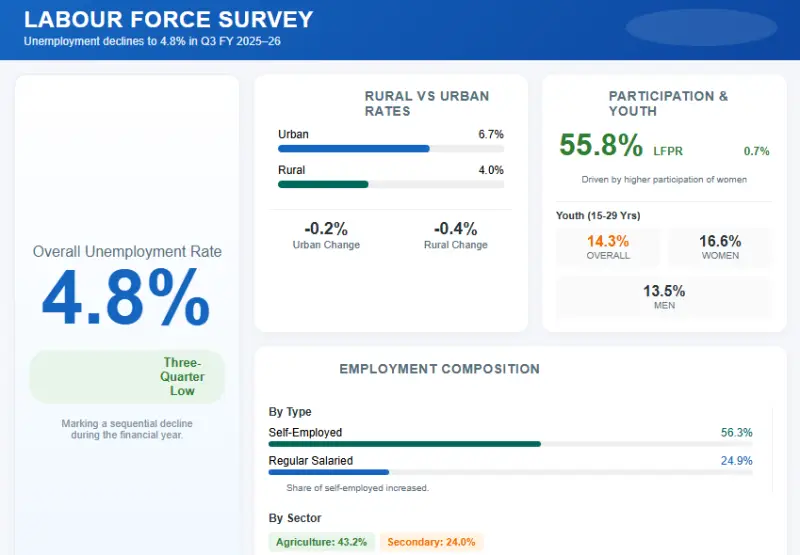
India's unemployment rate declined to 4.8 per cent in the October–December quarter (Q3) of financial year 2025–26, marking the lowest level in three consecutive quarters according to the latest Periodic Labour Force Survey (PLFS) released by the National Statistics Office (NSO).
Key Highlights of Q3 FY 2025–26
- Overall unemployment: Fell to 4.8% from 5.2% in Q2 (July–September 2025)
- Rural areas: Unemployment dropped to 4.0% from 4.4% in the previous quarter
- Urban areas: Joblessness eased to 6.7% from 6.9%
- Labour Force Participation Rate (LFPR): Rose to 55.8% from 55.1%, indicating more people joined the workforce
Women Drive Workforce Expansion
The rise in LFPR was primarily driven by increased participation of women in both rural and urban labour markets. Female LFPR reached 34.9% in Q3, showing steady improvement in women's economic engagement, a crucial indicator for India's inclusive growth.
Youth Unemployment Shows Improvement
Unemployment among young people (aged 15–29 years), who form the bulk of first-time job seekers, declined to 14.3% from 14.8% in Q2:
- Young women: 16.6% (down from 17.0%)
- Young men: 13.5% (down from 14.1%)
Changing Nature of Employment
The composition of India's workforce showed notable shifts during the quarter:
- Self-employment increased: Share of self-employed workers (including own-account workers and unpaid household helpers) rose to 56.3% from 55.8%
- Salaried jobs declined: Proportion of regular salaried employees fell to 24.9% from 25.4%, raising questions about quality of employment
- Agriculture employment rose: 43.2% of workers were in agriculture (up from 42.4%), while secondary sector (manufacturing, construction) saw a marginal decline to 24.0% from 24.2%
Understanding PLFS Methodology
The PLFS uses the Current Weekly Status (CWS) approach to measure unemployment. Under this framework, a person is counted as unemployed if they did not work even for one hour during the reference week but were actively seeking or available for work.
From January 2025, the NSO revamped the PLFS sampling methodology to generate more reliable monthly and quarterly estimates. Key changes include:
- Introduction of a rotational panel sampling design where each selected household is surveyed four times—once initially and three follow-up visits in subsequent months
- This design ensures 75% sample overlap between consecutive months, improving data consistency and reliability
- First-time generation of quarterly employment indicators separately for rural and urban areas at the all-India level
Why This Matters for Competitive Exams
These statistics are vital for understanding India's labour market dynamics:
- Falling unemployment alongside rising LFPR indicates genuine job creation rather than workforce discouragement
- Increased women's participation signals progress on gender inclusion but also reflects possible distress employment in some cases
- Rising self-employment and agricultural jobs versus declining salaried positions highlight structural challenges in creating quality formal sector jobs
- PLFS methodology changes make historical comparisons with pre-2025 data difficult, important caveat for answer writing