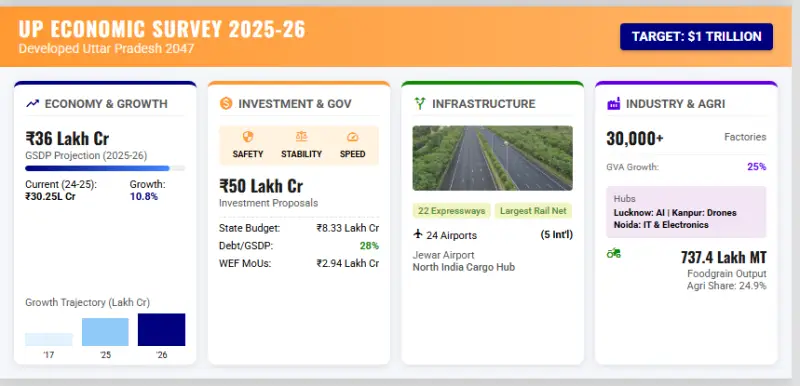
Uttar Pradesh made history on February 9, 2026, by presenting its first-ever Economic Survey in the State Legislative Assembly, becoming the first Indian state to release a comprehensive annual economic review modelled on the Union Government's Economic Survey.
Key Highlights of UP Economic Survey 2025-26
Finance Minister Suresh Khanna tabled the survey, which outlines a detailed roadmap for transforming Uttar Pradesh into a $1 trillion economy through an investment-led growth strategy aligned with the Viksit Uttar Pradesh 2047 vision.
Economic Growth Performance
- GSDP Expansion: The state's economy more than doubled in eight years, growing from ₹13.30 lakh crore (2016-17) to ₹30.25 lakh crore (2024-25), with a projection of ₹36 lakh crore for 2025-26.
- Consistent Growth: Uttar Pradesh recorded an average annual growth rate of 10.8% – among the highest among major Indian states.
- Per Capita Income: GSDP per capita rose from ₹61,142 (2016-17) to ₹1,26,304 (2024-25), reflecting improved living standards.
Investment-Led Growth Strategy
- Investment Pipeline: The state has attracted investment proposals exceeding ₹50 lakh crore, demonstrating strong domestic and global investor confidence.
- Triple S Model: UP's growth foundation rests on three pillars, Safety (improved law and order), Stability (predictable policies), and Speed (fast project approvals).
- Digital Governance: Platforms like Nivesh Mitra provide time-bound clearances with complete transparency for businesses.
- Global Recognition: Memorandums of Understanding worth ₹2.94 lakh crore were signed at the World Economic Forum 2026, highlighting UP's rising global investment profile.
Infrastructure Development
- Expressway Hub: Uttar Pradesh is emerging as India's expressway capital with 22 expressways planned or under development, including operational corridors like Yamuna, Agra-Lucknow, Purvanchal, and Bundelkhand Expressways.
- Aviation Expansion: The state is developing multiple airports with the Noida International Airport (Jewar) positioned to become North India's major cargo and logistics hub. The first phase of its 87-acre multi-modal cargo terminal can handle 2.5 lakh tonnes of cargo annually.
- Rail Connectivity: UP possesses one of India's most extensive railway networks, supporting freight and passenger movement across the state.
Industrial & Manufacturing Growth
- Factory Expansion: Registered factories in the state have crossed the 30,000 mark.
- Industrial GVA: Industrial Gross Value Added recorded robust growth, positioning UP among top-performing states.
- Cluster Development: Strategic specialisation is driving regional growth:
- Lucknow → Artificial Intelligence hub
- Kanpur → Drone manufacturing and testing centre
- Noida → Information Technology and electronics manufacturing hub
Agriculture Sector
- Foodgrain Leadership: Uttar Pradesh remains India's largest foodgrain producer with output of 737.4 lakh metric tonnes.
- Farmer Support: Increased Minimum Support Price (MSP) procurement, expanded micro-irrigation coverage, and improved irrigation infrastructure have boosted farm incomes.
- Crop Diversification: Government schemes successfully expanded acreage under pulses and oilseeds to enhance nutritional security and farmer returns.
Social Development
- Healthcare: Health budget increased to ₹46,728.48 crore (2025-26), improving access and reducing out-of-pocket expenses. Institutional deliveries reached 96.12% and full immunisation coverage was achieved for children under five years.
- Governance Reforms: Technology-driven policing, women safety initiatives, and fast-track courts have strengthened public trust and institutional efficiency.
Fiscal Management
- Total budget size reached ₹8.33 lakh crore for 2025-26.
- Debt-to-GSDP ratio stood at 28% lower than the national average reflecting prudent fiscal discipline.
Why This Matters for Competitive Exams
This landmark Economic Survey is significant because:
- UP became the first Indian state to institutionalise an annual Economic Survey practice.
- It provides a data-backed framework for understanding state-level economic planning in India's federal structure.
- The Triple S investment model offers a replicable governance template for other states.
- UP's journey from a low-base economy to a high-growth trajectory offers important lessons in policy continuity, infrastructure push, and ease of doing business reforms.
- The survey bridges national development goals (Viksit Bharat 2047) with state-level implementation strategies.
For exam aspirants, focus on the growth trajectory (10.8% CAGR), GSDP figures (₹13.30L cr → ₹30.25L cr → ₹36L cr projection), Triple S model, expressway development, and cluster-based industrial strategy as high-probability questions in economy and governance sections.