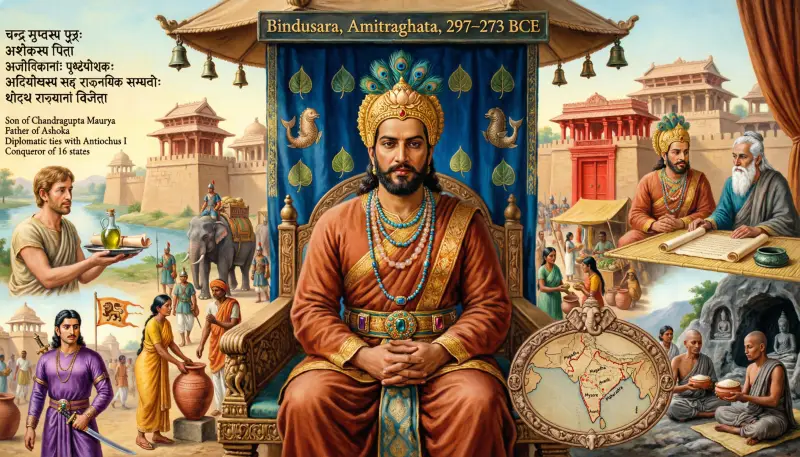
Introduction to Bindusara
Bindusara was the second emperor of the Mauryan Empire, one of the largest and most powerful empires in ancient Indian history. He succeeded his father, Chandragupta Maurya, and laid the foundation for his son, Ashoka the Great, to expand the empire further. For competitive exams like UPSC, SSC, Banking, and State PSC, understanding Bindusara's reign is crucial as it bridges the gap between the establishment of the empire and its golden age.
Reign Period and Titles
Bindusara ruled approximately from 297 BCE to 273 BCE. He is known by several titles in historical texts and inscriptions:
- Amitraghata: Meaning "Slayer of Foes" or "Destroyer of Enemies". This is his most famous title found in Sanskrit texts.
- Amitrachanda: Another variation meaning "Fierce to Enemies".
- Allitrochades: The name used by Greek historians like Athenaeus.
- Devanampriya: Though more commonly associated with Ashoka, some inscriptions suggest its early usage.
Family and Succession
Bindusara's family tree is a frequent topic in Indian History GK questions:
- Father: Chandragupta Maurya (Founder of Mauryan Empire).
- Mother: Queen Durdhara (According to some Jain texts).
- Grandfather: Chanakya (Kautilya) served as his mentor and Prime Minister initially.
- Children: The Mahavamsa states he had 101 sons. Ashoka was one of them. Susima was the eldest son and heir apparent.
- Succession: After Bindusara's death in 273 BCE, a war of succession broke out between Ashoka and Susima. Ashoka eventually emerged victorious after a gap of 4 years.
Administration and Empire Expansion
Bindusara maintained the strong administrative framework established by Chandragupta. Key highlights include:
- Expansion: He extended the Mauryan Empire into the Deccan region. It is said he conquered 16 states, extending the empire up to Mysore in the south.
- Limitations: The empire did not extend to the extreme south (Chola, Pandya, Satyaputra kingdoms) or Kalinga (which was conquered later by Ashoka).
- Provincial Governance: He appointed his son Ashoka as the Governor of Ujjain and another son, Susima, as the Governor of Taxila.
Foreign Relations
Bindusara maintained friendly diplomatic relations with the Hellenistic world. This is a key point for UPSC Ancient History:
- Greek Ambassadors: Deimachus was sent as an ambassador to Bindusara's court by the Syrian King Antiochus I.
- Diplomatic Requests: According to Greek historian Athenaeus, Bindusara wrote to Antiochus I requesting sweet wine, dried figs, and a sophist. The King sent wine and figs but replied that Greek laws forbade selling a sophist.
- Egypt Relations: There were also contacts with Ptolemy II Philadelphus of Egypt.
Religion and Beliefs
Unlike his son Ashoka, Bindusara's religious inclinations were more diverse:
- Ajivika Sect: Bindusara is known to have patronized the Ajivikas, a sect founded by Makkhali Gosala. He donated caves to Ajivika monks in the Barabar Hills.
- Buddhism: While he respected Buddhism, he did not adopt it as a state religion. Some sources suggest he followed Brahmanical traditions.
- Tolerance: He maintained a policy of religious tolerance, allowing various sects to flourish within the empire.
Important Facts for Competitive Exams
Quick revision points for SSC, RRB, and Banking GK:
- Capital: Pataliputra (modern-day Patna).
- Death: 273 BCE (Cause of death is not clearly recorded, though some legends suggest illness).
- Key Minister: Chanakya served him until Chanakya's death.
- Greek Name: Amitrochates.
- Conquest: Known for conquering the land between the two seas (Arabian Sea and Bay of Bengal), referring to the Deccan plateau.
- Source Material: Information comes from Greek accounts, Puranas, Buddhist texts (Mahavamsa, Dipavamsa), and Jain texts.