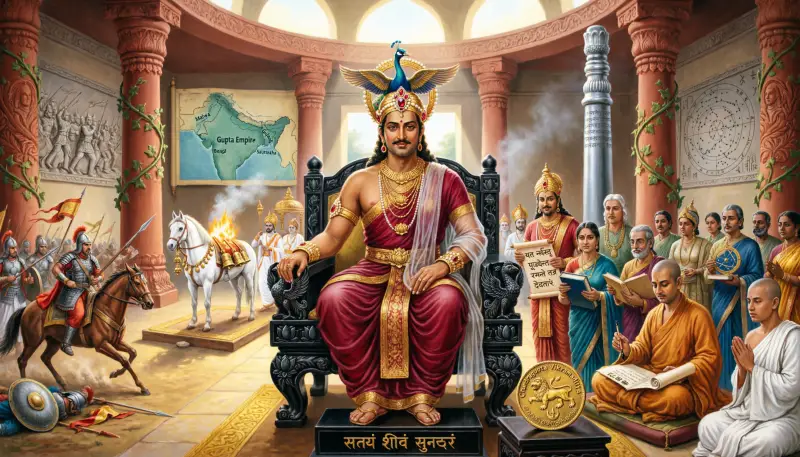
Chandragupta II Vikramaditya – Complete Guide for Competitive Exams
Chandragupta II, also known by his title Vikramaditya, was one of the greatest emperors of the Gupta Empire who ruled from approximately 375 CE to 415 CE. His reign marked the Golden Age of Ancient India, characterized by remarkable achievements in military conquests, administration, art, literature, science, and trade. This comprehensive guide covers all important facts about Chandragupta II for UPSC, SSC, Banking, RRB, and State PSC examinations.
Introduction and Early Life
Chandragupta II was the son of Samudragupta and Queen Datta Devi. He succeeded his father to become the third major ruler of the Gupta Dynasty. He adopted the title Vikramaditya, which had been first used by a Ujjain ruler in 58 BC as a mark of victory over the Sakas. His reign is considered the peak period of the Gupta Empire in terms of territorial expansion, cultural development, and economic prosperity.
Major Military Conquests and Wars
Chandragupta II was a skilled military strategist who expanded the Gupta Empire through a series of successful military campaigns. The most important military achievements include:
- Conquest of Western Kshatrapas (Shakas): The most celebrated achievement was his systematic campaign against the Western Shakas who controlled the prosperous regions of Gujarat and Malwa. He defeated and destroyed the Saka chieftain Rudrasena III and annexed his territories.
- Access to Western Seaports: By defeating the Shakas, Chandragupta II gained control over several ports on the western coast, which facilitated trade with Western countries and boosted the economy.
- Expansion into Bactria: Historical evidence suggests Chandragupta II conquered the Bactria region and occupied areas near the Oxus river, extending Gupta influence into Central Asia.
- Defeat of Sassanids: Some historical records attest to victories against the Sassanid Empire, showcasing the military might of the Gupta Empire under his rule.
- Consolidation of Northern India: He successfully consolidated power across northern India, making the Gupta Empire one of the largest and most powerful empires of ancient times.
Administration During Chandragupta II's Reign
The administration of Chandragupta II witnessed a mix of Mauryan and Scythian principles. Key features of his administration include:
- Provincial System: The territory was divided into many provinces which were ruled by governors appointed by the emperor.
- Decentralized Governance: Local administration was given considerable autonomy while maintaining central authority.
- Efficient Revenue System: Land revenue was the main source of income, collected systematically from agricultural lands.
- Strong Military Organization: The empire maintained a well-organized standing army with infantry, cavalry, and war elephants.
- Justice System: The king was the supreme judge, but local courts handled most civil and criminal cases.
Cultural and Literary Achievements
Chandragupta II was a great patron of art and literature. His court was adorned by the famous Navratna (Nine Gems), a group of nine extraordinary scholars and artists:
- Kalidasa: The greatest Sanskrit poet and dramatist who composed masterpieces like Shakuntala, Meghaduta, Raghuvamsa, and Kumarasambhava under Chandragupta II's patronage.
- Amarasimha: Sanskrit lexicographer and poet, author of Amarakosha, a famous Sanskrit thesaurus.
- Varahamihira: Renowned astronomer and mathematician who made significant contributions to astrology and astronomy.
- Aryabhata: Great mathematician and astronomer (some sources place him in this period).
- Vetala Bhatta: Scholar and poet in the royal court.
- Ghatakharpara: Famous poet known for his lyrical compositions.
- Dhanvantari: Physician and expert in Ayurveda.
- Kshapanaka: Scholar and astrologer.
- Shanku: Architect and engineer.
Religion and Religious Policy
Chandragupta II was a devotee of Lord Vishnu and followed Vaishnavism. Important religious aspects include:
- He made the figure of Garuda (the vahana of Vishnu) the emblem of the Gupta flag.
- He styled himself as a devoted follower of Vishnu in his inscriptions.
- Despite being a Vaishnavite, he maintained religious tolerance and supported Buddhism and Jainism.
- The famous Chinese pilgrim Faxian (Fa-Hien) visited India during his reign and documented the religious harmony and prosperity of the empire.
- Many temples and religious structures were built during this period.
Iron Pillar of Delhi – Historical Significance
One of the most remarkable achievements associated with Chandragupta II's reign is the Iron Pillar of Delhi:
- The iron pillar is a metal structure 7.21 metres (23 feet 8 inches) high with a 41-centimetre diameter.
- It was constructed during the reign of Chandragupta II (375-415 CE).
- The pillar has not rusted for over 1600 years, showcasing the advanced metallurgical knowledge of ancient India.
- It contains a Sanskrit inscription in Brahmi script that honors King Chandra (identified as Chandragupta II) and dedicates the pillar to Lord Vishnu.
- The inscription records the king's victories in battle and his devotion to Vishnu.
- This pillar stands as a testament to the scientific and engineering excellence of the Gupta period.
Economy and Trade
The Gupta Empire under Chandragupta II experienced unprecedented economic prosperity:
- Trade with Western Countries: Control over western seaports enabled flourishing trade with Rome, Persia, and other Western nations.
- Agricultural Prosperity: Land revenue system ensured stable income and agricultural development.
- Coinage: Gold coins (Dinars) of high purity were issued, depicting the king in various poses including playing the veena.
- Urban Development: Cities like Ujjain, Pataliputra, and Mathura became major commercial and cultural centers.
- Craftsmanship: Textiles, metalwork, and pottery industries flourished during this period.
Important Facts for Competitive Exams
Here are the most important points about Chandragupta II that frequently appear in UPSC, SSC, Banking, RRB, and State PSC examinations:
- Reign Period: 375 CE to 415 CE (approximately 40 years)
- Title: Vikramaditya (meaning "Power of Sun" or "Sun of Prowess")
- Father: Samudragupta
- Mother: Datta Devi
- Capital: Ujjain (also Pataliputra)
- Major Conquest: Western Kshatrapas/Shakas (defeated Rudrasena III)
- Court Poet: Kalidasa (greatest Sanskrit literary figure)
- Chinese Visitor: Faxian (Fa-Hien) visited during 399-414 CE
- Religion: Vaishnavism (devotee of Lord Vishnu)
- Emblem: Garuda (vehicle of Vishnu)
- Famous Monument: Iron Pillar of Delhi
- Period Known As: Golden Age of Ancient India
- Coin Depiction: Shown playing veena on gold coins
- Successor: Kumaragupta I
Legacy and Historical Significance
Chandragupta II's legacy as a patron of art, literature, and culture continued to influence subsequent rulers for centuries. The architectural and cultural achievements of his reign set standards for future Indian empires. His reign represents the climax of cultural development in ancient India. The Gupta period under Chandragupta II is often compared to the Periclean Age of Athens due to its remarkable intellectual and artistic achievements. The administrative systems, trade networks, and cultural traditions established during his rule had lasting impacts on Indian civilization.
Why Chandragupta II is Important for Exams
Questions about Chandragupta II regularly appear in various competitive examinations because:
- He represents the peak of the Gupta Golden Age
- His reign covers multiple topics: history, art, culture, administration, economy
- Associated with famous personalities like Kalidasa and Faxian
- Linked to important monuments like the Iron Pillar of Delhi
- His military conquests shaped the political map of ancient India
- His period saw developments in science, mathematics, and astronomy
This comprehensive guide on Chandragupta II Vikramaditya covers all essential information needed for competitive exam preparation. Students should focus on the key facts, dates, conquests, cultural achievements, and important personalities associated with his reign for maximum scoring potential in examinations.